
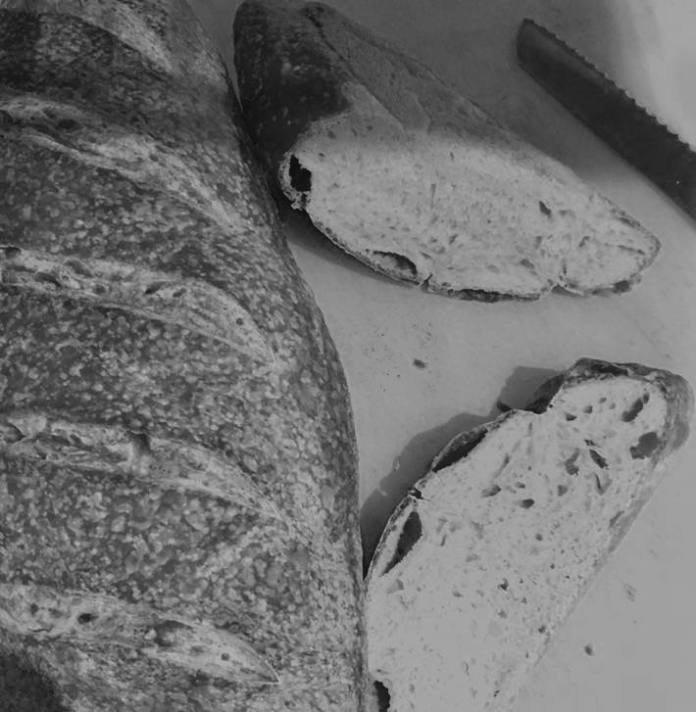
It’s early morning, the sun is shining bright and you can catch a glimpse of it trough the gap on the curtains. The birds are already busy and you can hear them singing away outside. There’s no better way to compliment this, than freshly baked bread and a hot or cold beverage of your choice.
A nice crusty Ciabatta, or a soft and buttery Brioche or an all time favorite from my childhood Pan de Sal. That soft, sweet and airy bread roll I grew up eating in Manila.
In this series titled OUR DAILY BREAD, we’ll be discussing about bread and it’s place in our daily diet. Some have it for breakfast, some have it as a snack, while others may have it with every meal. Some like it white, some like it brown with grains or even sweet with fruits.
What is BREAD apart from being just flour and water? Bread is one of the oldest food group that dates back to way before cooking was even documented. Before microwaves and combi ovens and kitchenaids. In biblical times we have heard so many stories and parables that focused on bread. One of which is the “breaking of bread”, which signifies fellowship of the early christians back then. Same can be said today, no meal with family or friends is truly complete without any type of bread present on the table. Generations after generations, versions after versions it has evolved. If our ancestors knew how to make it, we should to.
That is our goal here, to learn the basics of how to make your own bread. Really it’s not rocket science. It’s just flour and salt and water and yeast. Oh but the yeast part is what freaks most people out, right? I get it, and based on my experience there is no knead to be afraid of it. As long as you follow the exact measurements of the main ingredients mentioned earlier you can never go wrong.
Ok so we start with the yeast. There are two types dry active and fresh yeast. Both of which work the same way. You measure it out and you dissolve it in warm water to activate it. Or you mix it with flour. Some say add sugar, some add a drop of honey, and some just leave it be and use the natural sugars of the flour to feed the yeast. I personally do the yeast in flour thing with no added sugar unless the recipe calls for it. What’s most important is the temperature of the water, too much on the warm side will kill it. Also remember that too much of added fat, or dairy, or salt and eggs will slower the growth of your dough or even kill the yeast.
Then we have the flour, depending on what type of bread you want to make, there are different grades of flour to suite your needs. Flour grades are measured by the protein content in the flour. The higher the protein the more dense the end result will be. Ok a bit of confusion there, just leave it for now. So for beginners in bread making I suggest you start with ALL PURPOSE FLOUR for now.
Water, water, water… An essential element of any recipe, is WATER, the importance of which is very often overlooked. A bread dough is roughly forty percent water. In making dough, the consistency depends clearly on the amount of water used in making it. The amount of water needed depends on the quality of the flour and the kind of bread we want to make. Water is needed to form the gluten and give the dough consistency. It is also the solvent or medium for substances like sugar and enzymes that are indispensable for the fermentation. The next essential role is its function in homogenizing all this substances throughout the dough during kneading. The water is also needed for swelling and gelatinisation of the starch. This in its turn improves the easy digestion of the bread. The distribution of the heat through the bread during baking is done by water in the dough. And finally water influences the organoleptic properties of the bread.
And lastly we come to the salt. Salt acts as a natural antioxidant in the dough and not only adds taste but especially helps bring out the flavors and aromas present in the flour and other ingredients. Next to its role in boosting the flavor of your bread, salt plays a role in tightening the gluten structure and adding strength to your dough. It helps the loaf to hold on to the carbon dioxide gas that is formed during fermentation, supporting good volume. Salt slows down fermentation and enzyme activity in dough. The salt crystals draw water away from their environment (salt is ‘hygroscopic’). When salt and yeast compete for water, salt wins and the yeast is slowed down. Because of its moisture maintaining properties, salt can prevent bread from getting stale but it can also (this is especially true in humid environments) absorb moisture from the air and leave you with soft crusts and soggy bread. For those of you wondering how much salt should you put in, the standard would be nothing below 1.5% and nothing over 1.8% of the total amount of flour.
Now that we have a fairly good understanding of the 4 main ingredients in bread making, let’s bake some bread!!!
BASIC BREAD
For this you will need a scale (a very accurate one). a set of measuring spoons and cups, a liquid measuring jug, a wooden spoon, a large mixing bowl, a couple of loaf pans or your baking tray.
480g (3 cups) all purpose flour (once you get a feel of it you can substitute for different grades according to your taste)
20g fresh yeast (7g/2 teaspoons dry active yeast)
8g (2 teaspoons) caster sugar
2.84g (1/2 teaspoon) salt
250ml (1 cup) warm water (NOT HOT WARM)
30g (2 tablespoons) melted butter
More melted butter for brushing
Step 1
– Combine flour, yeast and sugar your bowl. Using your hands rub the mixture together, this will help activate the yeast better. Make a well in the centre. Add the water, salt and melted butter.
Step 2 –
Use a wooden spoon to stir the mixture until well combined, then use your hands to bring the dough together in the bowl.
Step 3
– Turn the dough onto a lightly floured surface and knead for 8-10 minutes or until smooth and elastic. Kneading distributes the yeast evenly through the dough and develops and strengthens the gluten in the flour which will form the framework of the bread. The best way to knead is to use the heel of your hand to push the dough away from you and then lift it with your fingertips and fold it over itself towards you. Turn the dough a quarter turn and repeat. You can tell when the dough has been kneaded enough by pressing your finger into the surface of the dough – if it springs back, it has been kneaded sufficiently. If the dough hasn’t been kneaded enough, the resulting bread will have a holey, crumbly texture and poor structure.
Step 4
– Shape the dough into a ball. Brush a large bowl with more melted butter to grease. Place the dough into the bowl and turn it over to lightly coat the dough surface with the butter. This will stop the surface of the dough drying out as it stands, which can affect the rising process. Cover the bowl with plastic wrap or a damp tea towel and then place it in a warm, draught-free place to allow the dough to rise. A good place to stand it is on a wooden board on the door of the oven with the pilot light on, or in a sheltered, sunny spot. If the temperature is too high, it may kill the yeast, making the dough useless. The ideal temperature for rising bread dough is around 30°C.
Step 5
– Leave the dough in this spot until it is double its size. This process is known as “proving” and the time it takes will depend on where you stand the bowl and on the warmth of you kitchen. The slower the rising, the more even and close the bread texture will be. However, if the dough rises too slowly, or too rapidly, the final bread will have a less even texture and an unpleasant yeasty flavour. This quantity of bread dough should take between 45-75 minutes t double in size. When the dough is ready, it will retaining a finger imprint when lightly pressed. If left to rise for too long, the bread texture will be uneven and have large holes. If not left for long enough, it will have a heavy, dense texture.
Step 6
– Once the dough has doubled in size. Punch it down in the centre with your fist. This step, known as “punching” or “knocking” down the dough, release excess carbon dioxide produced by the yeast during rising so the final bread won’t have a “yeasty” flavour.
Step 7
– Turn the dough onto a lightly floured surface and knead again for 2-3 minutes or until smooth and elastic and returned to its original size.
Step 8
– Preheat oven to 200°C. Then drop it down to 175°C
Step 9
– Divide the dough into 2 equal portions and shape each into a smooth round. If the dough is unevenly divided and/or shaped unevenly, the final bread will be irregular in appearance. Depending on how rustic you want your bread to be. Place the portions of dough side by side in the greased loaf pan. Or just rolled in a baking tray. Brush lightly with the melted butter. Stand the pan in a warm, draught-free place, as before, for about 30 minutes or until the dough has raised.
Step 10
– Bake in preheated oven for 35 minutes or until golden and cooked through. The best way to tell when the loaf of bread is cooked is to tap it on the base with your knuckle – if it sounds hollow, it is cooked.
Step 11 – If baking in a Pan. Turn the loaf immediately onto a wire rack and allow to cool. If left in the pan, the loaf will sweat and the crust will become soft.
Step 12
– Once cool, store the loaf in a well-ventilated place at room temperature. This bread is best eaten on the day it is made. However, it makes great toast 1-2 days later. Make any stale leftovers into breadcrumbs and freeze in a sealed freezer bag to have on hand for later use. Or just feed the birds.
Happy Cooking and remember always cook with your HEART…
Stay tuned for more on this series.
 Cooking with Migs