
As the saying goes, ‘the best way to a man’s or a woman’s heart is through his or her stomach’. Bit of a brutal reality with so much truth in it and served with red wine jus on the side. Thanks to all these reality cooking shows of all sorts and to the food network, our knowledge and awareness about food and ingredients has broadened. To the point wherein everyone is a master chef. But to be a true master of this craft at home cooking for family and friends, or in a career in the kitchen, you must learn the right skills and proper execution so you could create the most delicious meals even out off simple ingredients.
So I guess with the title above and that introduction it’s quite obvious that this blog is going to be about cooking and about food and the kitchen etc… it’s more than that. It’s a personal compilation of some of my original recipes, some interpretations i have made of dishes by moms, grandmas, celebrity chefs and other chefs I have worked with who are not famous but just as passionate about creating scramcioulicious dishes as you and I. There will also be some real life stories a sort of like behind the scenes kinda thing.
But it’s not all about recipes and food. In here we will also discuss and share some basic skills you will need to know for you to perfectly create each dish like a seasoned pro. Skills like slicing, dicing and chopping stuff, how to handle a knife or a whisk or even use a measuring cup. Yes we all know the difference between a grater and a vegetable peeler, but really there are a hundred ways to peel a carrot, right?
As we go along we will also touch on things like the produce we use, how to source, handle and substitute them if needed. Yes i said substitute. There is nothing wrong with that. In the absence of what is necessary what is available is the best. See it’s really not the price tag of each item on the recipe that makes a dish worthy of 5 stars, it’s how it was prepared. I was thought to always COOK WITH YOUR HEART. To do so we must always incorporate the most important of all ingredients in every dish that we do and that is LOVE.
The introduction is now over, so now join me as we venture into my virtual kitchen where I invite you to COOK WITH ME…
We begin by discussing the most basic and important of all tools, which is present in any kitchen both commercial or domestic. To common i would say that it’s too easy to take it for granted or neglect. Allow me to introduce or reintroduce to you “The KNIFE”…
Just like in a carpenter’s tool box where you will always find the right tools for the right jobs. There are different knives for different jobs. (as shown below)
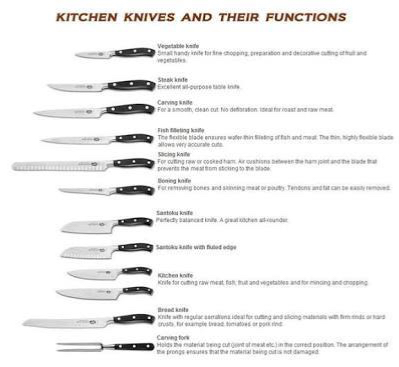
We will talk about all of them later on, but for now let as start with the most used of them all. The Kitchen Knife or as we call it in my realm THE CHEF’S KNIFE.
A classic chef’s knife, with its broad, tapering blade, sharp tip and chunky handle is the workhorse of the kitchen. Practicing with one will really make you a better cook: they are sharper, stronger and they do more of the work for you than smaller knives. This kind of knives will have a blade that will range from 6-12 inches, but for most people specially for our home cooks, 8 inches is the perfect length. For those of you looking at buying, look for a comfortable handle and a blade that is thicker at the base than at the tip. If it will fit your budget get a rather pricey knife that will last you a long time rather than super market knives that are sharp as spoons and practically useless. Or get an entry level chef knife to start with and practice on. My first set when I was starting was a Victorinox, it was a good entry level kit. I had most of them for 15 years before a kitchen fire burned welded them together sort of like a game of thrones thing but out of chefs knives.
Ok going back on topic. This knife can tackle 90 percent of all tasks requiring the use of a knife, such as breaking down vegetables, chopping herbs and salad leaves (but really it’s better to tear them with your hands), and slicing onions and scallions. It can also be used in simple meat cuts, like cubing beef for stew or slicing or butterflying chicken for a stir fry or kieves.
To do all of this, the knife has to be what they call “razor sharp”. Meaning it should be able to slice through paper straight out of the box. As long as you hone the blade and maintain thoughtful upkeep, it should remain sharp through moderate use for 6 months to a year before you need to sharpen it. Dull knives are not only frustrating to use, they’re dangerous. People try to compensate for a dull blade by applying more pressure, (which is tantamount to misuse) can cause the knife to slip off the food and nick a hand (or parts of it or worse).
A blade is a blade… a knife is a knife they say.
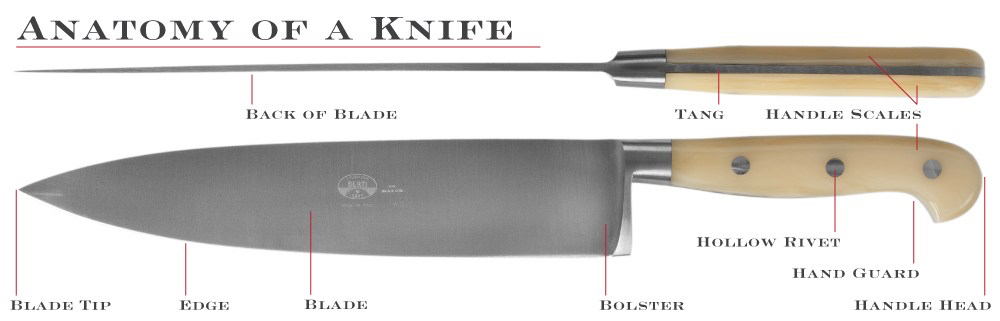
Before we go any further let’s talk about the parts of our knife.
Point
The sharp end of the blade that tapers to a point, hence the name. The point can be a Trail Point, Clip Point, Drop Point, Spear Point, Hawksbill Point, or Tanto Point, depending on whether it is above, even with, or below the blades spine. The point is important because it may be needed to start a hole, score something, or hold something in place, or maybe even stab something. If the point is dropped, the top part leading to the point is called the swedge, and if sharpened, is called a false edge.
Tip
The tip is used for delicate cutting.
Edge
The edge is the actual working part of a knife. Edges can be ground to different profiles, depending on what the knife is intended to be used for. An edge can be Chisel, Hollow-Ground, V, or Flat-Ground, Convex, Compound, or Serrated. Some edges can even have multiple bevels, such as half Hollow-Ground and half Serrated. The edge can be critical, depending on what the knife is used for. Hollow-Ground will give you a very fine, super-sharp edge, but it will be somewhat delicate, and will not stand up to heavy chopping, and batoning (batoning is hammering the blade through something with another object, such as a large stick, or polymer hammer…very hard on edges, and spines…). Hollow-Grinds are found on many fine chefs knives, slicing and boning knives, fillet knives and pocket knives. A ‘V’, or Flat Ground edge will be tough, and is great for chopping and batoning. It will hold an acceptable edge for most tasks, but will not take a super-fine edge for very clean slicing. You’ll see Flat Grinds on Meat Cleavers, Axes and Machetes. Chisel points are used mostly on tools. Convex, and Compound grinds are a compromise between hollow-grinds and Flat grinds. Serrated edges are common on many kitchen knives, and have great shearing power for making clean cuts through tough materials, like seat belts, gristle, and such. Some knives may even have the first half of the blade as a Hollow grind, and the last half of the blade with a Serrated grind. Some people like this combination.
Spine
The back of the blade, or, if it is a double-edged knife, the middle. The spine is the thickest part of the blade, and provides strength to the edge. As a rule, the thicker the spine, the stronger the blade. Spine thickness is also important because it effects the balance of the knife. Blade-heavy knives are great for chopping, but are somewhat unwieldy for delicate slicing. Handle-heavy knives are weak for chopping, but are great for delicate and intricate slicing. Sometimes a spine may have texturing along the last inch or so, near the handle, called “jimping”, which facilitates using the thumb on the back of the blade for extra control when making intricate and very delicate cuts.
Bolster
This is a crosspiece that protects the fingers from opposing blades sliding down your blade on a parry, during a knife-fight, or, in the case of kitchen knives, keeps your hand from sliding down onto the blade if your hand gets slippery.
Scales (handle)
The handle of the knife. Scales can be made from many materials, such as micarta, abalone, turquoise, various kinds of wood, plastic, rubber, leather, and polymers. The design of a handle can effect the ease with which a knife can be used for a specific purpose. A handle can be straight, or have finger grooves.
Heel
The lower part of the blade, close to the bolster.
Handle Fasteners
These are what hold the scales to the tang. They can be rivets, or screws. Rivets are commonly used because they are cheap and low-maintenance. The down-side is that if they ever loosen up, or you want to change the scales, they are difficult to remove. Screws make it easy to remove the scales for complete cleaning, or replacement, but you must take care to check them and tighten them regularly, because they can loosen up during use. You can eliminate this problem by removing them, coating them with Lock-Tite, then putting them back. I have never had a screw work loose after putting Lock-Tite, or a similar product on it. Some cheap knives eliminate the fasteners altogether, and the manufacturers just epoxy the handles to the tang. These work great, as long as all you are going to do with the knife is hang it on a wall. Otherwise, the handle will fail, quickly…
Tang
The tang is the unsharpened metal at the end of the blade that the handle attaches to. The tang can be a full-tang, meaning the metal extends all the way to the end of the scales, or a partial tang, meaning the metal only extends part of the way into the scales. Full tang knives allow much more force to be applied to the blade, and are the preferred style for most types of knives. The exception to the rule is folding knives, which by design, are impossible to make with a full-tang.
Butt
The back end of the knife.
Now that that’s out of the way, we move on to how we hold and handle our knife. Just like a samurai sword, when handled well it becomes an extension of our hand. And if misused, as mentioned earlier we may loose our hand or parts of it.
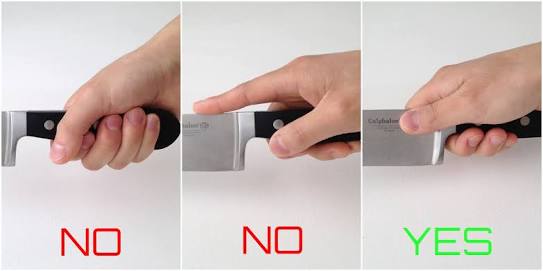
The images below shows us what is the proper way to hold our knife.
 The cutting hand (right or left), which grips the knife, is our lead actor, and the other hand is an important supporting actor. (which we will discuss later).
So grab your knife with a firm grip with the palm of the hand choking up on the handle and your thumb and index finger on each side of the blade. This is know as the Chef’s Grip, simply because it’s how majority of all chefs would hold their knives. This holding technique will give you more control and balance. This grip demonstrates the most efficient way to use the weight of the knife, the sharpness of its blade, and the strength of your arms, making it the easiest and best for cutting. Beginners may find that this takes some getting used to, but it definitely provides extra control over the blade.
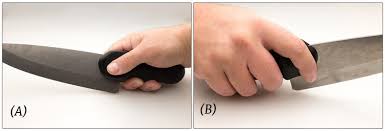
Another thing to remember is that when holding your knife, there should be enough clearance between the handle and the cutting board so your knuckles don’t hit the board. If you find that you’re tightly clutching the entire handle of the knife, just relax and loosen up. With practice, you’ll get used to this grip, and soon any other grip will feel very unnatural.
Now lets talk about the supporting actor in this cutting edge story
THE OTHER HAND
Now that our knife hand or the lead actor knows what to do, we need to make sure our other hand does, too. Our non-knife hand is called the “guiding hand,” and its job is to hold the food to keep it from sliding around on the cutting board. This puts it in a uniquely dangerous position. With the knife blade flying up and down, we need to keep those fingertips of ours tucked safely away, while still being able to firmly hold the food.
The ideal position for the other hand is called the bear claw, with the fingertips curled under and knuckles pressing down on the ingredient to keep it from rolling or sliding. It may feel odd, but it’s the safest place for your fingertips to be in relation to the cutting blade. Alternatively, bunch your fingertips together and rest the pads on top of the ingredient.
In a perfect world, while our hand that is holding the knife rocks forward and back to cut, the helping hand moves across in even increments, creating perfect slices. For those of you who are home cooks, remember this takes practice and practice makes perfect…
Now that we know the parts of our knife, we know how to hold and handle it right. we know the use of the other hand. We are ready to test this theories.
There are different cutting motions and styles and each for a specific application.
The Rocking Motion – a very traditional french style where the knife never leaves your board. and fit is lifted by the heel and guided by your OTHER HAND while feeding it the food to chop. This is good technique when chopping rather hard ingredients as it is almost impossible for the food to slip out. Thus making it a very safe motion to start with specials for beginners.
Push Cutting Motion – this style is when we lift the knife up totally and push it down on our ingredients in a forward slicing motion and then stop as soon as we hit the board, then start over again. 100 percent care and accuracy along with speed is needed when using such technique so as not to shave the top of your finger.
Pull Slicing Motion – a very simple motion that requires you to put the edge of your knife on the food and then draw the knife backwards in a long gentle motion, letting the weight of the knife do all the work.
Chopping Motion – this is like a poor sloppy excuse for a job, where you lift the whole knife from the board and work it back down on the food in a hammering motion. But then again sometime this is what is needed.
Now we go to the types of cuts mainly for fruits and vegetables. How hard is it to chop vegetables?, you may ask. Well it’s not that hard. But are many different types of cuts and while you may not use all of them, it’s important that you know and understand them. Having the knife skills and know-how to cut a brunoise, julliene, or batonnet will not only help you improve your knife skills, but also improve the visual appeal and professionalism of the dishes you create. Remember you eat with your eyes first.
Like most home cooks (and this is not a bad thing to be) you probably chop your items as fast as possible without knowing or understanding why it’s important to cut properly. Because that’s what home cooking is about, you would justify to yourself. I once worked for a guy who use to come into the kitchen and say “chef just whack my salad cause that how my mama makes it, none of this fancy bullshit”. Maybe there is a feeling of comfort in the midst of all that rustic mess. But from a professional point of view there are 2 important reasons why.
The first reason is uniformity. The best example for this is a parsnip or a carrot . It goes from very fat to very thin and most people will use a coin cut to slice it. This leaves very large and very small pieces in relation to itself. So the importance of cutting in uniform size is this. Well, large pieces take longer to cook right? Uniformity in cutting ensures that you have even, predictable cooking times. Nobody wants vegetables in their stew or stir fry that are mushy and hard at the same time!
The second reason is for good looks. Properly cut items look professional and have that visual appeal. Much of your appetite and the appetite of others stems from the appearance of the food you make. The way it is presented is of the utmost importance and a large percent of the satisfaction that people get from food comes from their eyes. Let me repeat myself, “people eat with their eyes”, and it’s important to never forget that!
Julienne. Julienne is a cutting technique where food is cut into long thin ‘matchstick’ like strips. This style of cut is commonly used as a garnish or on vegetables for stir fries. The more common vegetables seen julienned are carrots, zuchinni (zucchini), capsicum and celery but this cutting technique can be used on any firm vegetable or fruit. Hollow vegetables, like capsicum, have the ends chopped off and are then opened flat for slicing into julienne sticks. Whereas solid and/or round vegetables like carrots are cut with a sharp knife, on four sides to create a thick rectangular block. They are then sliced lengthwise, approximately 3mm (1/8 inch) thick. According to most, a standard Julienne is 4mm x 4mm x 5cm, or 1/8 x 1/8 x 2 inches. 1/8th of an inch is approx 3mm, so the sizes do vary from school to school. The slices are then stacked on top of each other, and are cut lengthwise to form thin uniform square sticks.
Chiffonade. This cut is mostly used with leafy greens and herbs for things like garnishes, salads and coleslaw. Its basically very fine shreds. The size definition is rather informal in that there seems to be no formal sizes so luckily that’s easier according to what is practical. This is generally done by stacking the leaves on top of each other, rolling them tightly to form a tube, and then cutting across the rolled leaves with a sharp knife to produce fine ribbons.
Jardiniere. These are vegetable “batons”. They are shorter and fatter with sizes ranging from 2cm x 4mm x 4mm (4/5 x 1/5 x 1/5 of an inch) or as large as 4cm x 10mm x 10mm (1.5 x 2/5 x 2/5 of an inch).
Brunoise. Brunoise is a fine dice cutting technique in which a fruit or vegetable is cut into a 4mm x 4mm x 4mm, or 1/8 x 1/8 x 1/8 inches fine dice. The food item is usually first julienned, then sliced across the ‘sticks’ to produce small cubes no bigger 3mm (1/8 inch) on each side. Common items to be brunoised are carrots, onions and turnips. This technique is often used to finely dice vegetables for sauteeing or as a garnish in some dishes. When used as a garnish, the cut should be consistent in size and shape, to ultimately help create a visual effect.
Macedoine. Macedoine is a cutting technique in which a fruit or vegetable is cut into cubes. Typically this cut would be used for vegetables that are used in soup or a stock base. Melons and other large fruits are also cut into macedoine cubes for fruit salad. An important rule when using this cut is to have a steady flat surface to cut on. If the food you’re cutting is round, cut one side to make it steady on the chopping board. This will make it easier to maintain control whilst cutting the fruit or vegetable. This is a slightly larger dice with sizes measuring from 5mm cubed to 10mm cubed (10mm is the more common size).
Paysanne. This translates as Peasant. This is done by slicing the food into thin relatively broad slices. Said to be about 1mm thick but the sizes are far more flexible. It really is the first cutting technique that we all learn when we first use a knife.
They are the basic knife skills you can practice with and get an good understanding of. It may take a while to master and once you have, you can move onto more advanced knife skills including butterflying, deboning, carving, and working with difficult objects.
Practice makes perfect, so get out there and start practicing your knife skills!!!
And remember always cook with your HEART…
 Cooking with Migs